
Reclassifying and Being Removed from the Sex Offender Registry in Ohio
Having to register as a sex offender in Ohio can permanently alter the course of your life. Because of the restrictions, monitoring requirements, and reputational impact tied to the registry, it is essential to understand what legal options may be available to reduce your tier, shorten your reporting obligations, or remove you from the registry entirely.
With help from an experienced sex crimes lawyer at Luftman, Heck & Associates, you may be able to put your conviction behind you and finally begin to rebuild your life. Call (513) 338-1890 to schedule a free consultation with an Ohio sex offender registration attorney serving Cincinnati and Hamilton County.
Understanding Ohio’s Sex Offender Registration Tiers
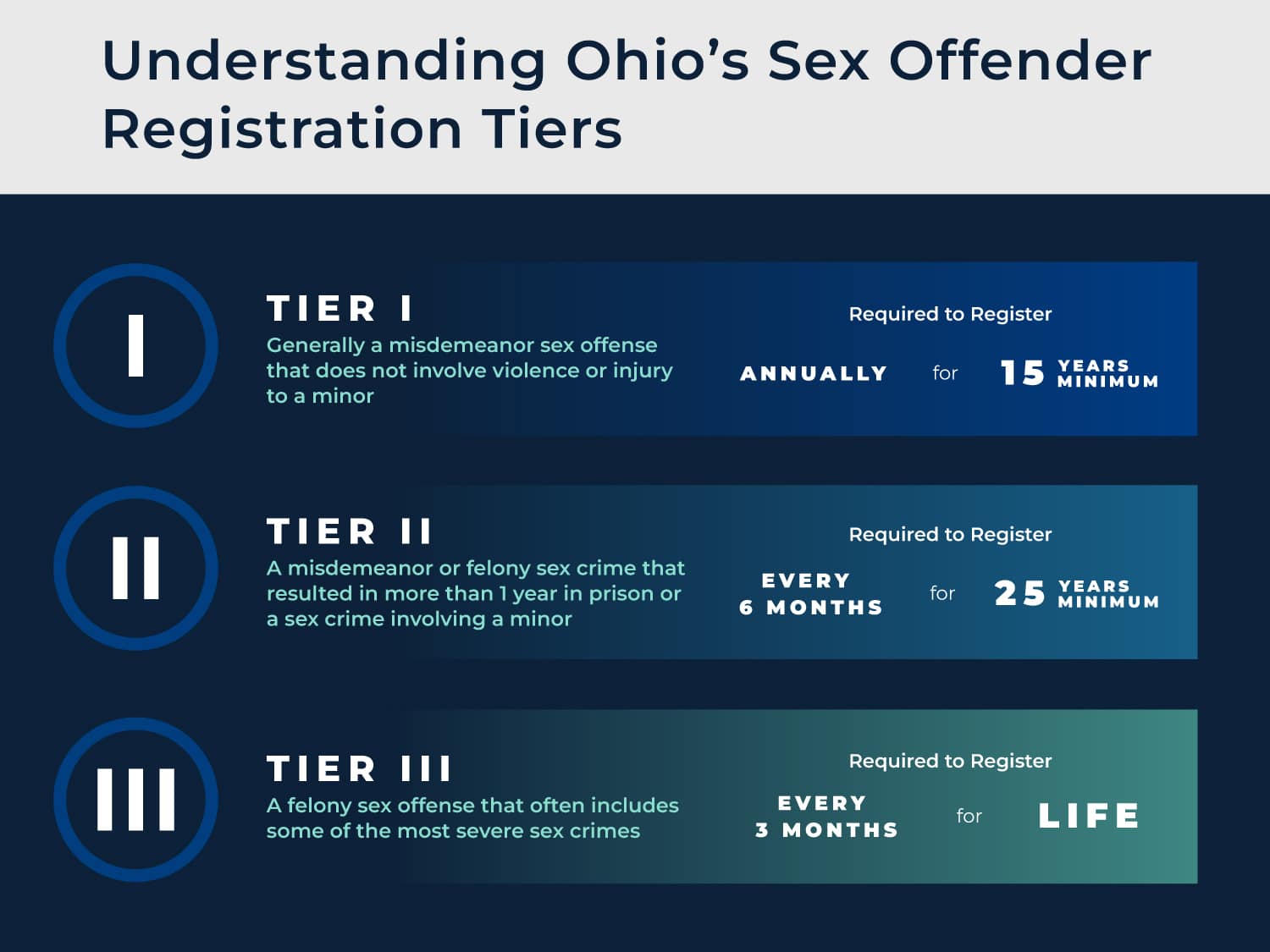
To understand Ohio sex offender registration requirements, you first need to understand how the registry is structured. Under Ohio’s current Adam Walsh Act framework (ORC Chapter 2950), there are three separate tiers, as follows:
Tier I
Tier I sex offenders are generally convicted of misdemeanor sex offenses that do not involve violence or injury to a minor. Those set at the Tier I sex offender registration level are required to re-register annually for a minimum of fifteen years.
Tier II
Tier II sex offenders could have been convicted of a misdemeanor or felony sex crime. They must have been sentenced to more than one year in prison or have committed a sex crime involving a minor. Those set at the Tier II sex offender registration level are required to re-register every six months for a minimum of 25 years.
Tier III
Tier III sex offenders have been convicted of a felony sex offense, often including some of the most serious sex crimes recognized under Ohio law. Those set at the Tier III sex offender registration level must re-register every three months for the rest of their lives, and they are also subject to community notification.
Who Has to Register in Ohio?
To determine which tier you will be classified under, the court looks at the offense of conviction. Here are some of the sex offenses that fall under each of the three registration tiers:
Tier I Sex Crimes
Some of the sex offenses that could result in a Tier I sex offender classification include:
- Voyeurism
- Importuning
- Gross sexual imposition
- Unlawful sexual conduct with a minor when the defendant is less than four years older than the alleged victim
- Promoting prostitution
- Menacing by stalking with sexual motivation
Adults classified as Tier I sex offenders may be required to verify and register once every twelve months for fifteen years. Juvenile offenders classified as Tier I must register for ten years.
Tier II Sex Crimes
Some examples of sex crimes that could be classified at the Tier II level include:
- Gross sexual imposition of a victim younger than thirteen years of age
- Pandering obscenity involving a minor
- Kidnapping with sexual motivation
- Abduction with sexual motivation
- Compelling prostitution
- Pandering sexually oriented materials involving a minor
- Child endangering
If you are classified as an adult Tier II sex offender, you can expect to register every 180 days for the next 25 years. Juvenile Tier II sex offenders must register every 180 days for the next 20 years.
Tier III Sex Crimes
Examples of sex offenses that will result in a Tier III sex offender classification include:
- The kidnapping of a minor
- Rape
- Sexual battery
- Gross sexual imposition of a minor under 12 years old
- Felonious assault with sexual motivation
Both adult and juvenile Tier III sex offenders must re-register every 90 days for the rest of their lives, and adult Tier III offenders are subject to community notification under ORC 2950.11.
The Adam Walsh Act vs. Ohio’s Pre-AWA Registration System
Ohio’s current tier system took effect on January 1, 2008, when the Ohio Adam Walsh Act (Senate Bill 10) replaced the older Megan’s Law framework. The two systems are not the same, and the difference matters when you are looking at reclassification.
Under the old Megan’s Law system, registrants were placed into one of three categories based on a judge’s individualized assessment of whether the person was a sexually oriented offender, a habitual sex offender, or a sexual predator. Classifications followed risk-based hearings, and many people were eligible to petition the court to terminate their registration after a set period.
Under the Adam Walsh Act framework, classification is determined entirely by the offense of conviction. There is no individualized risk assessment up front, and reporting periods are longer and stricter at every tier.
The Ohio Supreme Court has held that the Adam Walsh Act cannot be applied retroactively to people whose offenses occurred before January 1, 2008. In State v. Williams, 129 Ohio St.3d 344 (2011), and State v. Bodyke, 126 Ohio St.3d 266 (2010), the court ruled that pre-AWA registrants must remain under Megan’s Law classifications. As a result, two registrants in Hamilton County can be subject to entirely different rules depending on the date of the underlying offense.
If you were originally classified under Megan’s Law, your reclassification or termination options are governed by the pre-AWA statutes. If you were classified under the Adam Walsh Act, the AWA reclassification provisions apply. Confirming which system controls your case is one of the first questions a sex crimes attorney will work through with you.
Can You Be Reclassified or Removed from the Registry in Ohio?
There are several ways to reduce your tier, shorten your reporting obligations, or remove your name from the sex offender registry. The right path depends on whether you are an adult or were adjudicated as a juvenile, which classification system applies to you, the tier you currently sit in, and how much time has passed since you completed your sentence.
Petitioning for Reclassification or Declassification as an Adult
For most adults convicted of a sex offense under the Adam Walsh Act, declassification is not available. Adults required to register as Tier I, II, or III offenders generally cannot be fully removed from the registry through a standard petition, but you may be eligible for reclassification, a reduction in reporting frequency, or termination of registration in narrow circumstances.
Reclassification is possible when you can show that the current classification is no longer applicable or was excessive at the outset. For example, if your underlying conviction was overturned on appeal or modified, you may become eligible to be removed from the registry or to be placed at a lower tier. A history of compliance, treatment, and good conduct after release is also relevant evidence.
Which Court Hears the Petition
For Hamilton County residents, the petition is generally filed in the Hamilton County Common Pleas Court that handled the original conviction. If your conviction came out of one of the surrounding counties, the petition is filed in the Common Pleas Court in that county: Butler County, Clermont County, Warren County, or Brown County. Juvenile reclassification petitions are heard in the juvenile division of the court where the original adjudication occurred.
Evidence and Documentation to Prepare
Reclassification hearings are not a do-over of the original case. The court is looking forward, not backward, and it expects the petitioner to come prepared with concrete proof of rehabilitation and stability. Documentation that typically helps a reclassification petition includes:
- Proof of completion of any court-ordered sex offender treatment program, with a final report from the treatment provider
- Current sex offender risk assessment or psychosexual evaluation from a qualified evaluator
- Records showing full compliance with registration, address verification, and any community control or post-release control terms
- Proof of stable housing and employment
- Letters of support from employers, treatment providers, faith leaders, and family
- Evidence of community involvement, volunteer work, or continued education
- Documentation of any substance abuse or mental health treatment
- A clean criminal record since the original conviction
The stronger and more recent this documentation is, the more weight it tends to carry at the hearing.
What the Reclassification Hearing Looks Like
Reclassification hearings are typically held in front of the judge, with no jury. The prosecutor’s office is notified and given an opportunity to respond, and in many cases the victim or victim’s family also receives notice and may speak. Your attorney presents the documentation, calls any supporting witnesses (treatment providers, employers, family), and addresses the statutory factors the court must consider. The prosecutor may cross-examine witnesses, present the original offense record, and argue against modification. After both sides present, the judge will either rule from the bench or take the matter under advisement and issue a written decision.
What Judges Look For When Considering Reclassification
Reclassification decisions are highly individualized, but Hamilton County judges and judges across Ohio consistently weigh a similar set of factors when deciding whether to reduce a tier, shorten a reporting period, or terminate registration. In our experience handling these petitions, the factors that carry the most weight include:
- Time elapsed since the offense and since release. Courts are looking for a sustained period of law-abiding behavior, often well beyond the statutory minimum waiting period.
- Compliance history. A clean record of registration, address verification, and supervision counts heavily in your favor. Even one missed verification can be disqualifying.
- Rehabilitation and treatment. Completion of a recognized sex offender treatment program, with a strong final report, is one of the most persuasive pieces of evidence a petitioner can offer.
- Current risk assessment. A low-risk score on a current psychosexual or actuarial risk assessment from a qualified evaluator carries significant weight.
- Community ties. Stable housing, steady employment, family responsibilities, and community involvement signal that the petitioner has built a life worth protecting.
- Nature of the original offense. Judges weigh how serious the underlying offense was, the age of the victim, whether force was used, and how the offense compares to others within the same tier.
- Position of the prosecution and victim. Hamilton County prosecutors and victims have the right to be heard. Their position will not control the outcome, but it will be considered.
- Behavior during incarceration and supervision. Disciplinary records from prison and probation, plus any positive programming completed during incarceration, are part of the picture.
No single factor wins a reclassification hearing on its own, and no single negative factor is automatically fatal. Judges look at the full picture, which is why preparation and documentation matter so much.
Reclassification or Declassification for Juvenile Offenders
Tier I juvenile offenders are more likely to be eligible for declassification than any other category of registrant. Under ORC 2152.85, a juvenile classified as a Tier I or Tier II offender may petition for reclassification or declassification after a defined period, and Tier III juveniles may petition under ORC 2152.86 after 25 years of compliance.
Upon receiving a reclassification petition, the juvenile court will weigh the offender’s risk for reoffending, the treatment they have received, their behavior in the community since the adjudication, school and employment history, and any other relevant evidence. Ohio also recognizes that adolescent brains are still developing, and the courts have been more willing to modify or terminate juvenile registration than adult registration when the record supports it.
The court can continue the existing classification, modify the tier, or terminate sex offender registration requirements entirely.
How a Lawyer Can Help with Reclassification or Removal from the Registry
If you are interested in reclassification, there are several ways an Ohio sex crimes attorney can help. First, we analyze the specific details of your case to determine whether you meet the eligibility requirements under either the Adam Walsh Act or the pre-2008 Megan’s Law framework. If you are eligible, we gather the treatment records, risk assessments, employment and housing documentation, and supporting letters needed at your reclassification hearing.
If you are currently ineligible for reclassification, we look at whether your underlying conviction is open to challenge. If your sentence can be overturned or modified on appeal, you may become eligible for reclassification or declassification from the Ohio sex offender registry. We also handle the procedural side of the petition, the notice requirements, the response to the prosecutor, and the hearing itself.
Get Help from an Ohio Sex Offender Reclassification Lawyer Today
If you are required to register as a sex offender, you already know how much it affects every part of your life. Reclassification or removal from the registry can be one of the most meaningful steps you take toward protecting your future.
Do not hesitate to contact a reputable Cincinnati sex crimes lawyer at Luftman, Heck & Associates to find out whether you are eligible. You can reach us through our contact form or by phone at (513) 338-1890 to schedule your confidential case evaluation.